
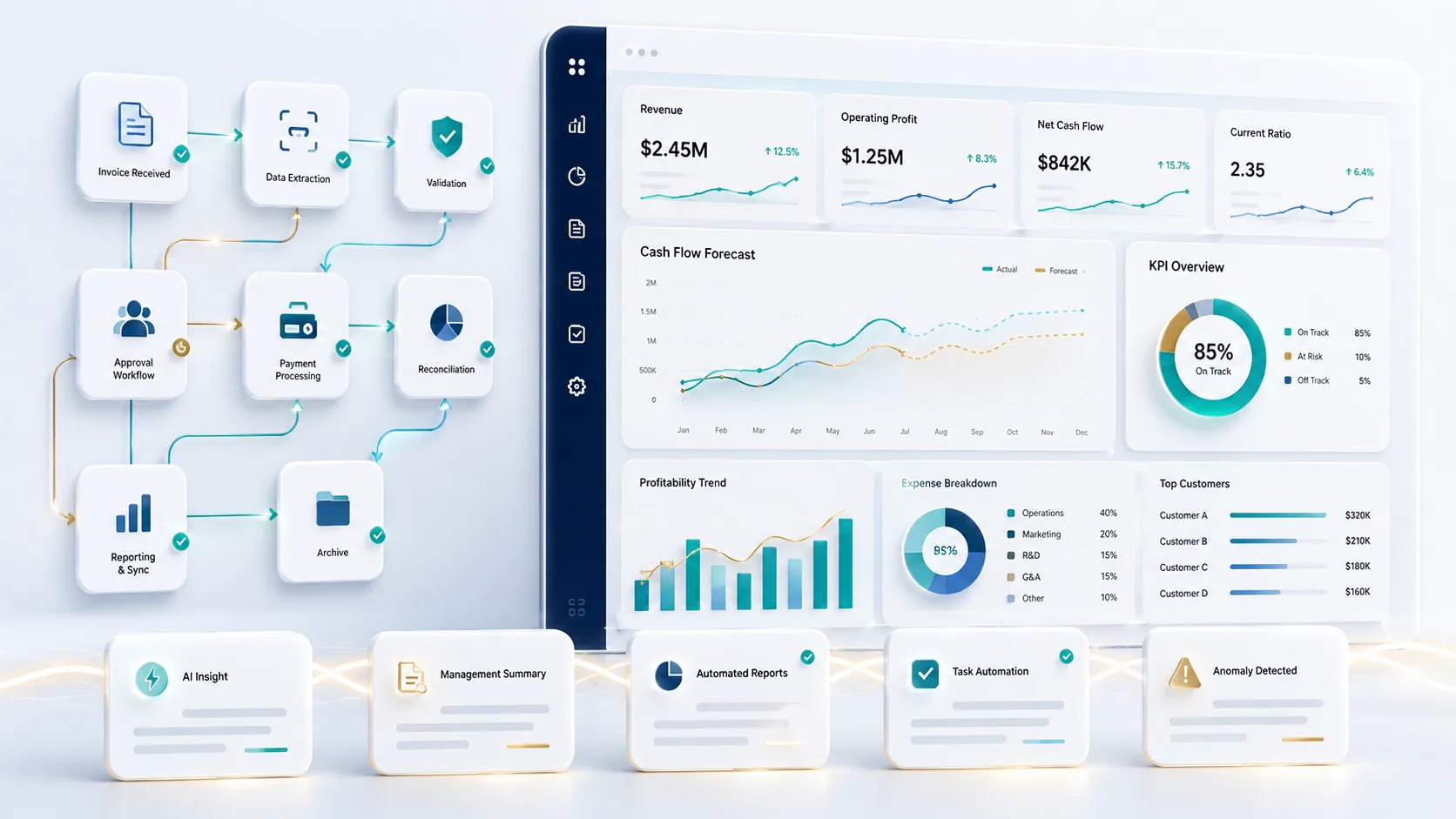
AI should solve practical finance problems
Businesses do not need AI for decoration. They need it to reduce manual work, improve reporting speed, support decision-making and remove repeated follow-up from daily operations. The best AI use cases in finance are often simple and practical: preparing summaries, routing tasks, reviewing exceptions, helping with forecasts and creating dashboards that leadership can actually use.
Automated reporting saves repeated effort
Many finance teams spend hours each month copying data, formatting reports and preparing summaries. Automation can standardize reporting templates, refresh dashboards and generate management notes from structured data. This does not remove professional review. It gives finance teams more time to interpret results instead of rebuilding the same report each month.
Invoice and approval workflows can become faster
Manual invoice processing creates delays, missing approvals and unclear responsibility. Automation can route invoices, trigger reminders, track approval status and create a clear audit trail. For growing businesses, this improves payment discipline and gives management better visibility over commitments.
Forecasting can become more responsive
AI-assisted forecasting can help teams review trends, test assumptions and compare scenarios. Cash-flow forecasting, revenue planning and cost projections still require judgment, but automation can make it easier to refresh models and identify changes that need attention.
AI agents can support business operations
AI agents can help with repeatable tasks such as answering internal process questions, summarizing documents, preparing meeting notes, drafting follow-up lists or guiding staff through SOPs. The safest approach is to start with bounded use cases where the agent supports the team and outputs are reviewed by responsible people.
The Strivano approach
Strivano focuses on automation that makes business sense. Before recommending tools, we look at workflows, reporting gaps, control risks, data quality and team adoption. The objective is to create an intelligent operating rhythm: fewer manual steps, clearer dashboards, better decisions and stronger accountability.
Frequently asked questions
It can be, when implemented with access controls, review steps, data protection and clear accountability.
Start with repetitive tasks that are time-consuming, low-risk and easy to measure, such as reporting templates, approval reminders or task dashboards.
Where AI automation creates practical finance value
AI becomes useful in finance operations when it is applied to real bottlenecks. These bottlenecks may include invoice routing, repetitive reporting, manual categorization, approval reminders, management summaries, KPI checks or recurring analysis. The best starting point is not to automate everything. The best starting point is to identify tasks that are repetitive, rules-based, time-consuming or frequently delayed.
Strivano treats AI automation as a business improvement tool. A finance team may not need a complicated AI platform at the beginning. It may need a better workflow, cleaner data, a dashboard that updates on time, and a simple automated summary that helps management understand what changed during the month. Practical automation builds trust because people can see the immediate result.
Automation should support people, not confuse them
Many companies delay automation because they assume it will be expensive, risky or difficult for the team to adopt. In reality, the first phase can be simple: document the process, remove unnecessary steps, connect the right data sources, set approval logic, and create a reporting rhythm that reduces manual follow-up. AI can then support summaries, alerts, checks and workflow assistance.
This is why Strivano combines finance knowledge with process thinking. The purpose is not to replace judgment. The purpose is to reduce repetitive effort so finance and management teams can spend more time on decisions, controls and growth.